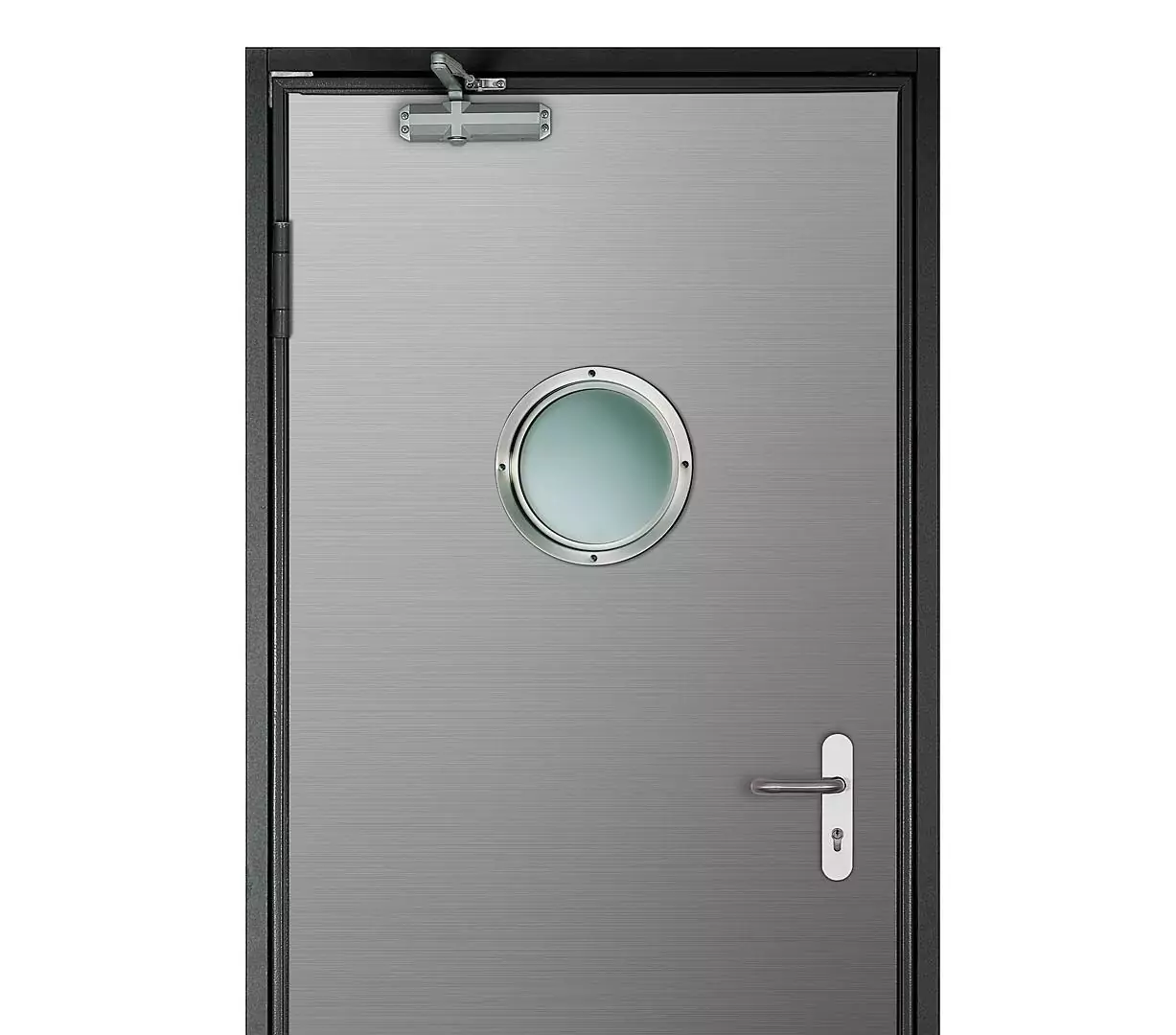
Certified metal fire doors are a key component of fire safety in any building. Fire-rating certificates guarantee that the doors have been tested and comply with current regulations regarding fire resistance, smoke control, and durability.
Having certified fire doors is not only a legal requirement in many cases, but also a guarantee of protection for people and property.
What are firewall certificates?
Fire-rated certificates are official documents issued by accredited laboratories that certify that a metal fire-rated door has passed fire resistance tests in accordance with specific standards.
- These certificates state:
- Fire resistance time
- Behavior in the presence of flames, heat, and smoke
- The durability of the self-closing system
- The regulations applied in the tests
European EI Certification for Metal Fire Doors
The European EI certification is one of the most widely used certifications in Europe for fire doors.
- E (Integrity): The door prevents the passage of flames and hot gases
- I (Insulation): limits heat transfer to the unexposed side
- EI2: indicates that the door has been tested from both sides
- 30, 60, 90, or 120 minutes: fire resistance time
Example: EI2 60 MN, a common rating for certified metal fire doors.
CE Marking on Fire Doors
The CE marking is mandatory for the sale of fire doors in the European Union.
- This label certifies that the door:
- Complies with the EN 16034 standard
- It has passed official laboratory tests
- It is manufactured under a factory production control system
- It includes a Declaration of Performance (DoP)
The CE marking guarantees that the product complies with European safety regulations.
Identification and Traceability of Metal Fire Doors
All certified metal fire doors must be identified with a visible label that includes key information such as:
- Fire Resistance Rating
- Dimensions
- Applicable Certificates
- Manufacturer’s Information
At Asturmadi Doors, doors are identified using laser-printed labels with QR codes, which allow for complete product traceability even years after they are manufactured.
Meaning of the C5 classification
In addition to fire resistance, fire doors are certified for the durability of their self-closing mechanism.
- C5 indicates a service life of 200,000 opening and closing cycles, ensuring the door functions properly throughout its entire service life.
This is a key consideration in buildings where doors are used extensively.
The Importance of Choosing Certified Metal Door Manufacturers
Choosing a manufacturer of metal fire doors with multiple certifications ensures:
- Regulatory Compliance
- Real Safety in the Event of a Fire
- Consistent product quality
- Long-term reliability
Certifications reflect a manufacturing process that is controlled and audited on a regular basis.
UL Certification for Fire Doors (UL 10B and UL 10C)
UL (Underwriters Laboratories) certification is one of the most internationally recognized certifications for fire doors, particularly in industrial and building projects that adhere to U.S. safety standards.
In the case of metal fire doors, there are two particularly common UL tests:
UL 10B – Fire Resistance Test
The UL 10B certification evaluates the door’s fire resistance when exposed to high temperatures according to a standardized fire curve.
During this test, it is verified that the fire door:
- It maintains its structural integrity
- Prevents the passage of flames for the certified duration
- It retains its function as a partitioning element
UL 10B doors are classified based on their fire resistance rating, such as UL 90, UL 120, and UL 180 minutes.
UL 10C – Fire Resistance and Positive Pressure Test
The UL 10C certification is an evolution of the UL 10B and is currently the most stringent and widely used.
In addition to fire resistance, UL 10C evaluates the door’s performance under positive pressure, simulating the actual conditions of a modern fire, where hot gases exert pressure on the door leaf and frame.
This test verifies that the metal fire door:
- Withstands fire under pressure
- It maintains its seal against hot gases
- It offers greater reliability in real-life fire situations
HOSE Test (Hose Stream Test)
HOSE test, or Hose Stream Test.
This test involves directing a high-pressure stream of water at the door immediately after the thermal test, simulating the intervention of firefighting services.
The purpose of the Hose Test is to verify that the door:
- It maintains its structural integrity
- It doesn’t collapse or open
- It continues to act as a barrier against fire
Passing this test confirms that the UL-certified fire door is capable of withstanding both fire and the thermal and mechanical impacts of fire suppression.
Importance of UL 10B, UL 10C, and the Hose Test
Fire doors certified to UL 10B or UL 10C and HOSE-tested are especially recommended for:
- International Projects
- Industrial Facilities
- Buildings that comply with U.S. or international codes
- High-risk environments
These certifications ensure a higher level of safety and reliable performance under real-world fire conditions.
This certification is particularly important for international projects or buildings that require global safety standards. If you need certified metal fire doors for your project, contact our technical team, and we’ll advise you on how to meet all regulatory requirements.